Our Research

We lead an interdisciplinary programme developing next-generation functional biomaterials by integrating principles from materials science, chemical biology and biomedical engineering. We specialise in the rational design and chemical functionalisation of advanced nanostructures for targeted drug delivery, bioimaging and real-time sensing. A central focus is the development of nitric oxide-releasing nanomedicines for cardiovascular regeneration, with an emphasis on creating intelligent delivery systems capable of navigating complex biological environments, responding to pathophysiological stimuli and restoring vascular homeostasis.

The Challenge


The cellular environment exists in a delicate equilibrium between reducing and oxidising conditions. This redox balance governs processes from metabolic regulation to cellular signalling, and its disruption underpins the pathogenesis of cardiovascular disease. Nitric oxide, a pivotal redox-active mediator, sits at the heart of this paradigm — modulating vascular homeostasis, mitochondrial function and inflammatory cascades. Yet its therapeutic potential remains constrained by challenges in spatiotemporal delivery and targeted bioactivity. Our work confronts this unmet clinical challenge through an innovative nanomedicine framework, redefining how NO-based therapeutics are engineered.
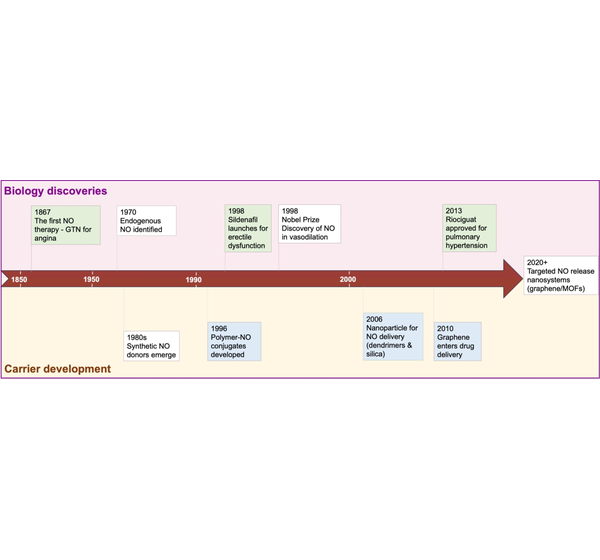
Timeline of nitric oxide biology discoveries and carrier development, 1850 to present
From glyceryl trinitrate for angina in 1867 to targeted NO-release nanosystems today: two centuries of nitric oxide biology and the carriers built to deliver it.
Research Areas


Our research is organised around several interconnected themes spanning nanomedicine, redox biology and cardiovascular therapeutics.

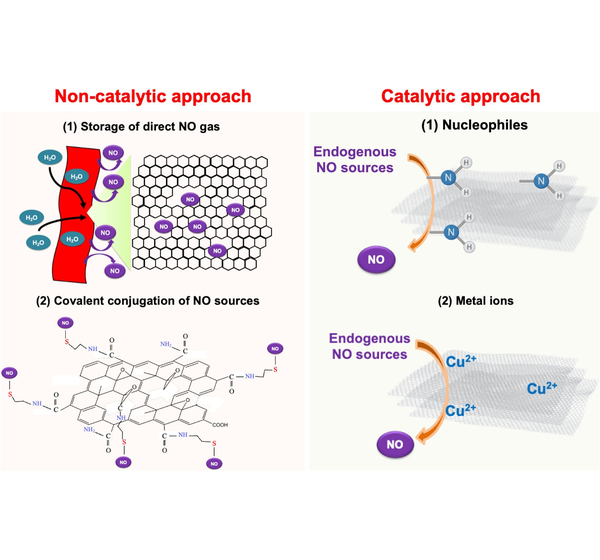
Catalytic and non-catalytic approaches to nitric oxide release
Area 01

Nitric Oxide Nanomedicine

We design nanomaterials that store and release nitric oxide with precision. Two complementary strategies run through this work. In the non-catalytic approach, NO is either stored directly as a gas within porous nanostructures or covalently conjugated to the material through S-nitrosothiol and diazeniumdiolate chemistries, releasing on contact with physiological triggers. In the catalytic approach, the material itself generates NO from endogenous sources already circulating in the body, using surface nucleophiles or immobilised metal ions such as copper to decompose S-nitrosothiols at the site of action.

Catalytic systems are self-replenishing in principle, offering a route past the finite payload that limits conventional donors — a significant advantage for implants intended to function over months rather than hours.

S-nitrosothiols Porous graphene Copper catalysis Controlled release
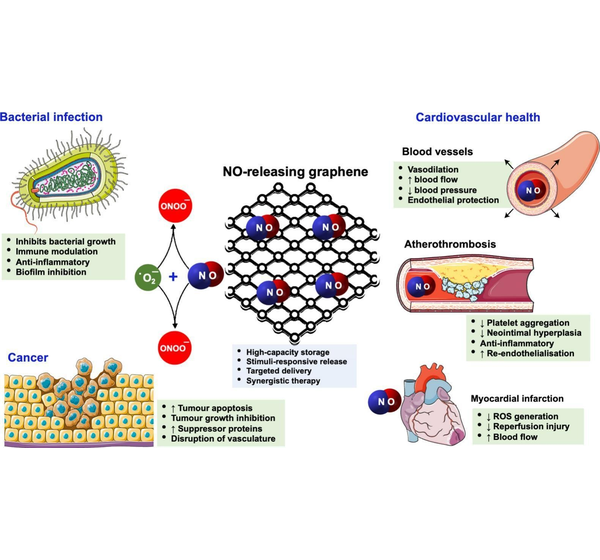
NO-releasing graphene across cardiovascular, antibacterial and cancer applications
Area 02

Targeted Drug Delivery

Delivering a gasotransmitter to the right place at the right time is the central difficulty in NO therapeutics. We develop redox-responsive nanodrug excipients capable of navigating the biochemical gradients of the cardiovascular system, using pH-selective permeabilities and oxygen tension to guide cargo — NO-releasing materials and NO donors — to subcellular targets in diseased tissue.

The same platforms carry beyond the cardiovascular system. NO-releasing graphene shows antibacterial and antibiofilm activity through peroxynitrite generation, and disrupts tumour vasculature while promoting apoptosis, giving a single materials platform relevance across infection, oncology and vascular medicine.

Hypoxia-responsive pH-selective Subcellular targeting Peroxynitrite
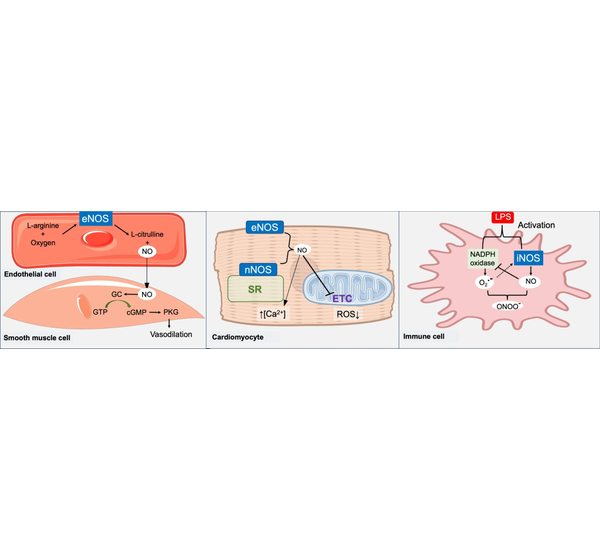
Nitric oxide signalling in endothelial cells, cardiomyocytes and immune cells
Area 03

Nitric Oxide Biology

Designing better NO therapeutics requires understanding what NO actually does, cell type by cell type. In the endothelium, eNOS converts L-arginine to L-citrulline and NO, which diffuses to adjacent smooth muscle and drives the guanylate cyclase–cGMP–PKG axis that produces vasodilation. In cardiomyocytes, eNOS- and nNOS-derived NO modulates calcium handling at the sarcoplasmic reticulum and restrains the mitochondrial electron transport chain, lowering reactive oxygen species. In immune cells, iNOS induction alongside NADPH oxidase activity determines whether NO resolves inflammation or forms damaging peroxynitrite.

We interrogate these pathways directly, developing advanced synthetic platforms for real-time imaging of NO at subcellular resolution to illuminate how NO fluxes relate to mitochondrial dysfunction, oxidative stress and endothelial pathology.

eNOS / nNOS / iNOS Redox signalling Mitochondrial function Real-time sensing
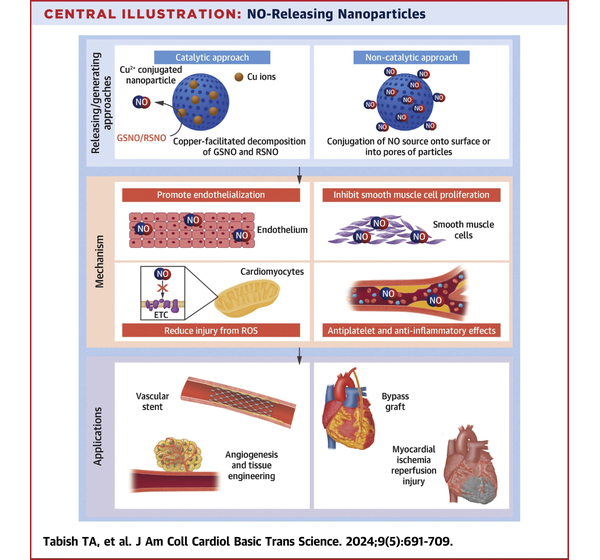
NO-releasing nanoparticles: mechanisms and cardiovascular device applications
Area 04

Next-Generation Devices

One of our flagship efforts is the design and fabrication of cardiovascular implants for controlled, sustained and stimulus-responsive therapeutic action. NO-releasing surfaces address the two failure modes that have dogged vascular devices for decades: they promote re-endothelialisation of the implant surface while simultaneously inhibiting smooth muscle cell proliferation, the driver of restenosis.

Applications span vascular stents, bypass grafts, angiogenesis and tissue engineering scaffolds, and protection against myocardial ischaemia–reperfusion injury. To evaluate them properly we have also built an ex vivo perfusion platform for testing interventional devices under physiologically realistic flow, bridging bench characterisation and pre-clinical work.

Stent coatings Bypass grafts Re-endothelialisation Ex vivo perfusion

How We Work


Materials by design

Rational design and chemical functionalisation of advanced nanostructures, with synthesis and characterisation guided by the biological problem rather than the other way round.

Biology at the bench

Vascular biology, redox measurement and real-time sensing in living systems, so that materials are tested against the mechanisms they are meant to engage.

Translation in mind

Close collaboration with engineers, chemists, pharmacists and clinicians, bridging the gap between fundamental redox biology and devices that could reach patients.

Work With Us

We welcome enquiries from researchers who want to work at the interface of nanomaterials, redox biology and cardiovascular therapeutics — and we currently have three fully funded DPhil projects on offer.